Wild cats are fierce predators as well as being one of my favourite types of animal. In this blog post I chose to write about the Eurasian lynx because it is quite an impressive creature but also relatively unknown.
The Eurasian lynx was once quite common in all of Europe. By the middle of the 19th century, it had become endangered in most countries of Central and Western Europe. There have been some successful attempts to reintroduce this lynx to forests. I will talk about the reintroduction into forests later.
Although the Eurasian lynx is not found in Japan, fossils of the it or closely related species from the late Pleistocene era and onward have been excavated from locations in Japan, indicating that its extinction there was caused by humans during the J?mon period (this is the time in Prehistoric Japan from about 16,500 years ago until about 2,300 years).
The Eurasian lynx has been listed as of least concern on the ICUN Red List since 2008 because it is widely distributed, and most populations are considered stable. The Eurasian lynx has been re-introduced to several forested mountainous areas in Central and south east Europe; these re-introduced populations are small, less than 200 animals.
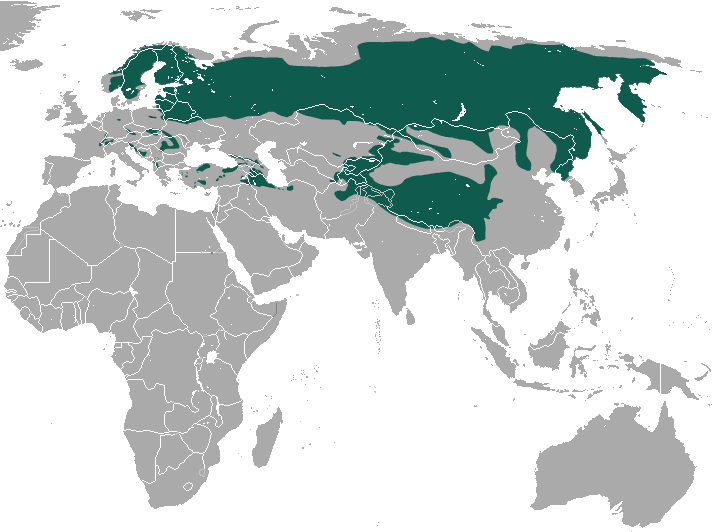
Where the Eurasian lynx can be found.
During the summer the Eurasian lynx has a short, reddish or brown coat which is usually more brightly coloured in animals living at the south of its range. In winter, this is replaced by a much thicker coat of silky fur that changes from silver-grey to greyish brown. The underparts of the animal, including the neck and chin, are white all through of the year. The fur is almost always marked with black spots, although the number and pattern of these are very different for each animal.
Lynx prey largely on small to large sized mammals and birds. Among the recorded prey for the Eurasian lynx are hares, rabbits, marmots, squirrels, dormice, other rodents, martens, grouse, red foxes, wild boar, chamois, young moose, roe deer, red deer, reindeer and other animals.
Female lynxes construct dens in secluded locations, often protected by overhanging branches or tree roots. The den would usually be lined with feathers, deer hair and dry grass to provide bedding for the young. At birth, Eurasian lynx kittens weigh 240 to 430 grams and are blind and helpless. They initially have plain, greyish-brown fur, getting the full adult colouration at around eleven weeks of age. The eyes open after ten to twelve days. The kittens begin to take solid food at six to seven weeks when they begin to leave the den. The den is abandoned two to three months after the kittens are born but the young usually remain with their mother until they are around ten months of age.
I’m glad that, unlike many beautiful creatures in the wild today, the Eurasian lynx is not an endangered species and I hope to see them in the wild one day.
February 8, 2017
LOL i am sied
February 21, 2017
Hey it is me!